API Governance in IBM API Connect: Create Rules and Test Against an API
IBM API Connect Governance turns security policy into machine-checkable rules. This walkthrough creates a custom OAuth2 ruleset, selects those rules in a validation scan, and runs them against an API so non-compliant definitions fail before publish.
What We Are Enforcing
The mybank-oauth-check ruleset requires every API to:
- Use an OAuth2 security definition (type must match oauth2)
- Reference the approved myBank provider via x-ibm-oauth-provider
- Declare at least one explicit scope
- Never use the implicit grant
- Never clear security at the operation level with an empty array
Step 1 — Create the Governance Ruleset
In the provider org, open API Governance → Rulesets and create a new ruleset named mybank-oauth-check (version 1.0.0). Paste the rules below, or import the YAML as a ruleset file.
Note: API Connect Governance rulesets are based on the open-source Spectral linter. The given / then / severity shape you write here is the same Spectral rule model — API Connect runs those checks as governance scans and scorecards.
name: mybank-oauth-check
title: myBank-oauth-check
description: ""
ruleset_version: 1.0.0

rules:
  - title: no-implicit-grant-type
    id: 4cf01579-a7f6-4ac2-8bf9-7ab41da14162
    name: no-implicit-grant-type
    version: 1.0.0
    description: Implicit grant is disallowed org-wide.
    given:
      $.securityDefinitions[?(@.type=='oauth2')]
    severity: error
    then:
      - function: schema
        functionOptions:
          schema:
            type: object
            required:
              - flow
            properties:
              flow:
                not:
                  enum:
                    - implicit
                type: string

  - title: no-operation-level-security-bypass
    id: 85d45013-144e-4bbb-915e-b253a505512a
    name: no-operation-level-security-bypass
    version: 1.0.0
    description: No operation may override the API-level requirement with an empty security array.
    given:
      $.paths[*][*].security
    severity: error
    then:
      - function: schema
        functionOptions:
          schema:
            type: array
            minItems: 1

  - title: oauth-provider-registered
    id: 94fcbbe3-eac5-4191-b63d-2778a85b874b
    name: oauth-provider-registered
    version: 1.0.0
    description: Every security definition must reference the approved myBank OAuth2 provider.
    given:
      $.securityDefinitions[*]
    severity: error
    then:
      function: schema
      functionOptions:
        schema:
          type: object
          required:
            - x-ibm-oauth-provider
          properties:
            x-ibm-oauth-provider:
              type: string
              pattern: ^inEdgeOAuth2Provider-\d+\.\d+\.\d+-[a-f0-9]{4}$

  - title: oauth-required-scopes-defined
    id: 689ad9c9-d3e5-4c23-88d2-346d8d808e03
    name: oauth-required-scopes-defined
    version: 1.0.0
    description: Every OAuth2 security definition must declare at least one explicit scope.
    given:
      $.securityDefinitions[*]
    severity: error
    then:
      field: scopes
      function: schema
      functionOptions:
        schema:
          type: object
          minProperties: 1

  - title: oauth-security-definition
    id: 84743e6e-3064-4384-88f0-d1ef2d4766a
    name: oauth-security-definition
    version: 1.0.0
    description: OAuth2 Provider not defined.
    given:
      $.securityDefinitions[*]
    severity: error
    then:
      field: type
      function: pattern
      functionOptions:
        match: ^oauth2$
Save and publish the ruleset so it becomes available for validation scans in the provider org.
Bonus: adidas publishes its OpenAPI (OAS) Spectral rules publicly — a useful reference when designing your own org checks: adidas/api-guidelines .spectral.yml.
Step 2 — Select the Rules for Validation
Start Validate APIs with ruleset. On Select rules, choose the five rules from mybank-oauth-check — all of them in this example.
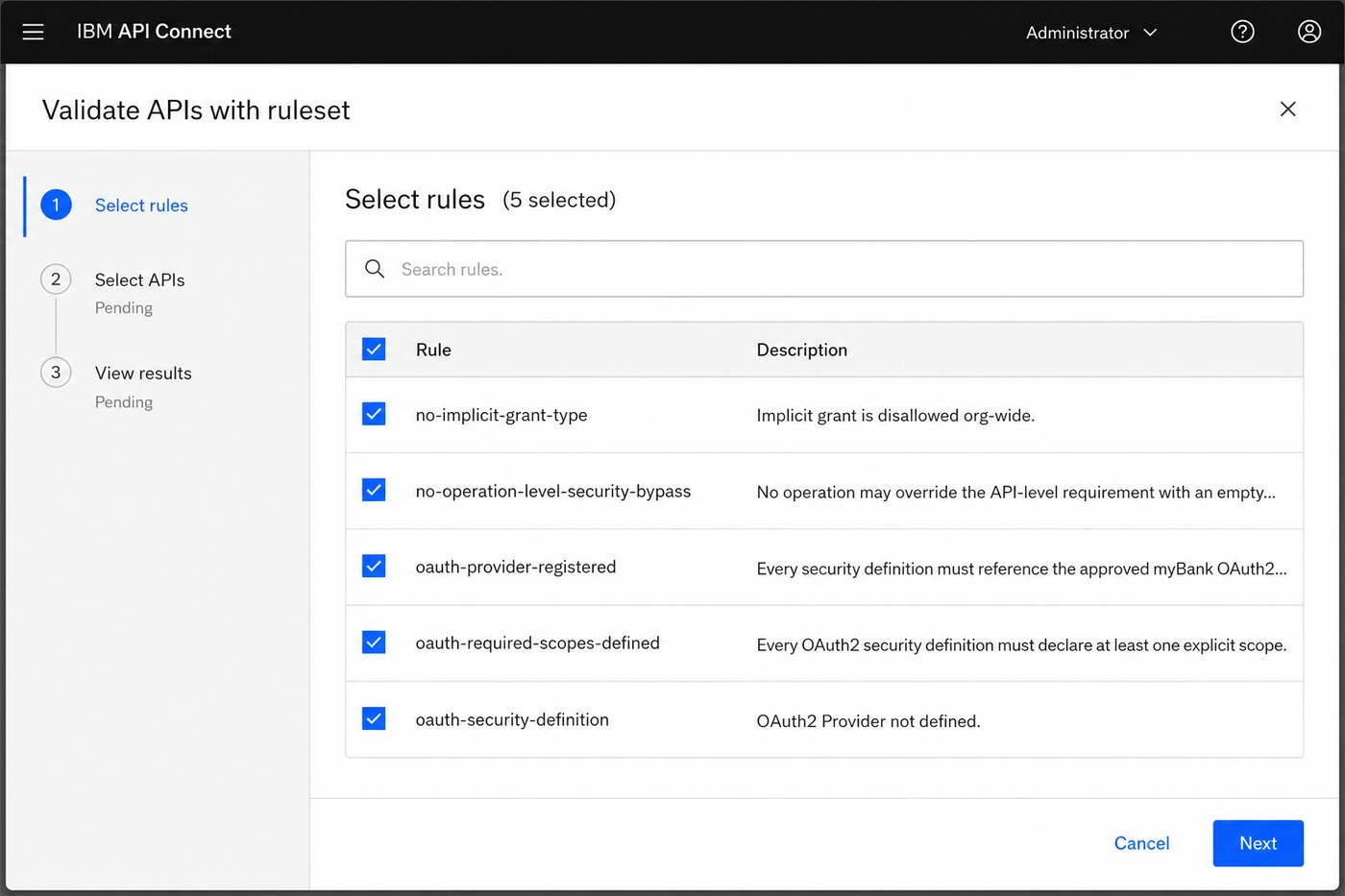
| Rule | What it catches |
|---|---|
| no-implicit-grant-type | OAuth2 flow: implicit |
| no-operation-level-security-bypass | Operation security: [] that strips API-level auth |
| oauth-provider-registered | Missing or invalid x-ibm-oauth-provider |
| oauth-required-scopes-defined | Empty or missing scopes |
| oauth-security-definition | Security definition type not oauth2 |
Continue to Select APIs and pick the API you want to test — here, balance-transfer-api:1.0.0.
Step 3 — Run the Scan and Read the Results
Open View results. Against a non-compliant definition, the scorecard returns error-level findings tied to specific rules.
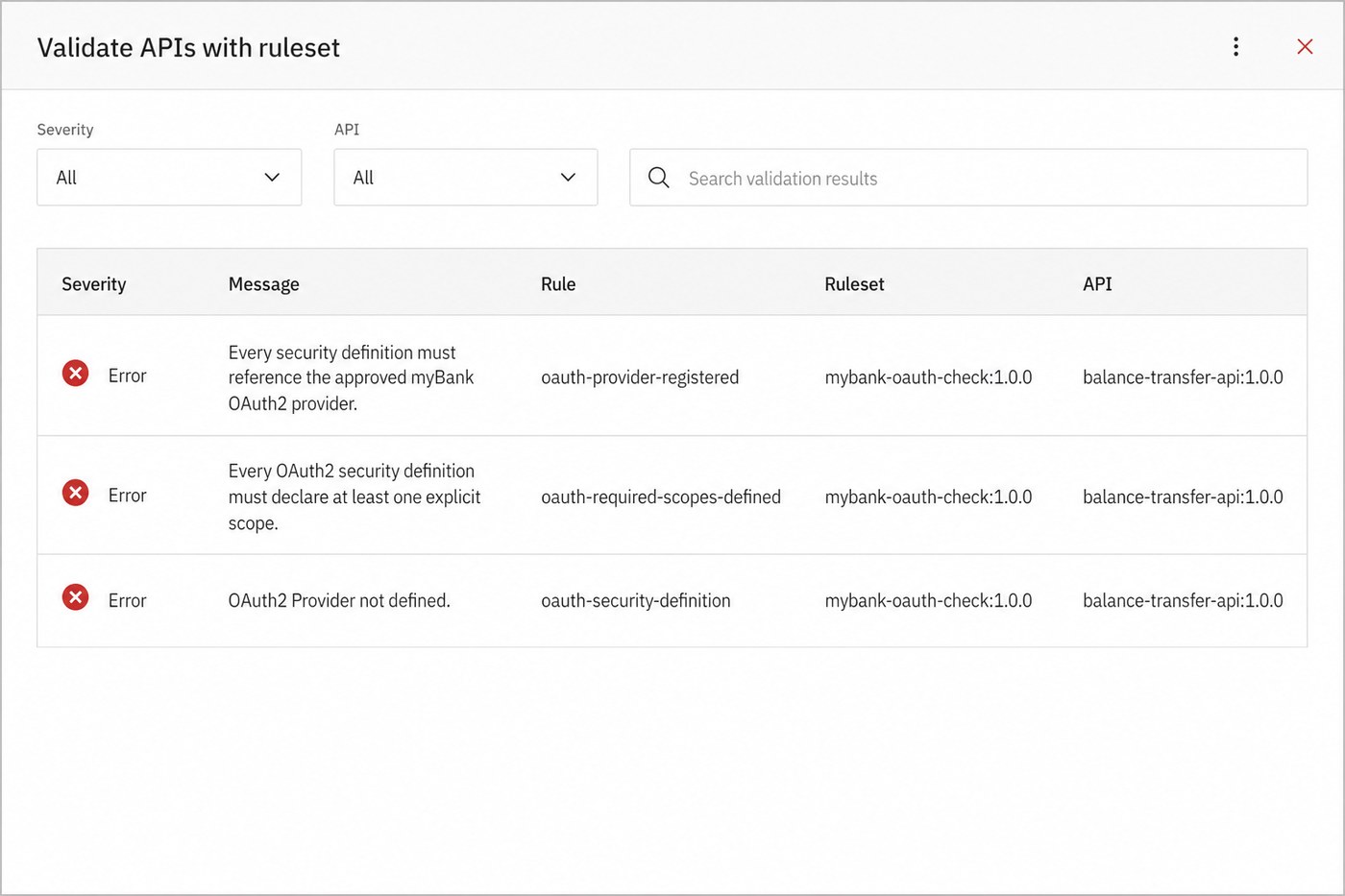
In this run, balance-transfer-api:1.0.0 fails three rules in mybank-oauth-check:1.0.0:
- oauth-provider-registered — no approved myBank OAuth2 provider reference
- oauth-required-scopes-defined — no explicit scopes declared
- oauth-security-definition — OAuth2 provider / type not defined as required
Each row tells you the severity, message, rule name, ruleset version, and API — enough to fix the OpenAPI definition without guessing.
Step 4 — Fix the API and Re-test
Update the API definition so it satisfies every rule, then re-run the same validation:
- Add a security definition with “type”: “oauth2”.
- Set x-ibm-oauth-provider to a value matching the approved provider id (for example inEdgeOAuth2Provider-1.0.0-a1b2).
- Declare at least one scope under scopes.
- Use a non-implicit flow (for example accessCode / authorization code).
- Remove any operation-level security: [] overrides.
Re-validate with the same five rules selected. A clean scorecard means the contract now meets org OAuth2 policy and is ready for the next publish gate.
Key Takeaways
- A ruleset encodes OAuth2 policy once; every scan reuses the same checks.
- Select rules → Select APIs → View results is the fastest loop for testing a new ruleset against a real API.
- Error messages map 1:1 to rule names, so fixes are specific (x-ibm-oauth-provider, scopes, type, flow, operation security).
- Catching failures on balance-transfer-api before publish keeps non-compliant definitions out of the catalog.